

Accommodation grants
University of Naples Federico II (www.unina.it) offers 15 grants/awards to doctoral and young doctors.
Special Issues
The scientific committee of the co-located conferences in collaboration with the guest editors will select the best papers from those presented in the conferences to be considered for publication in the following Special Issues:

Extended versions of selected papers will be published in the International Journal of Interactive Multimedia and Artificial Intelligence (ISSN: 1989 - 1660, JCR (2024): 2,4 (Q3))

Authors of selected papers will be invited to submit an extended and improved version to a Special Issue “New Trends in eHealth Technologies for Smart Cities” published in MDPI Smart Cities Journal (ISSN: 2624-6511, JCR (2024): 5.5 (Q1))
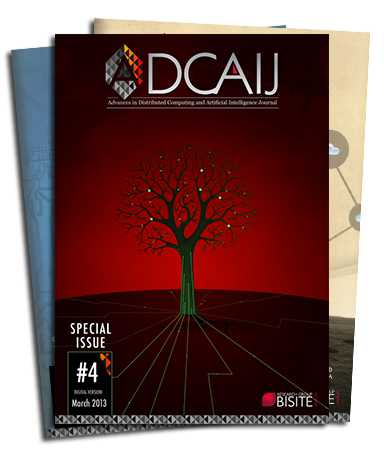
Authors of selected papers from PAAMS and the co‑located events will be invited to submit an extended and improved version of their work to the Advances in Distributed Computing and Artificial Intelligence Journal (ADCAIJ) (ISSN: 2255‑2863), which is indexed in Web of Science and Scopus, and listed in DOAJ, ProQuest, Google Scholar, WorldCat, Dialnet, Sherpa ROMEO, Dulcinea, Ulrichsweb, BASE, and Academic Journals Database. Journal metrics: JCR (2024) – Journal Impact Factor (JIF) 1.6, Q3 in Computer Science, Artificial Intelligence; JCI (2024) – category placement Q4; SJR (2024) – 0.219. The journal has also been awarded the FECYT Quality Seal (9th edition, 2025).

To Be Updated
Demonstration Award
The best demo paper in PAAMS'26 will be awarded with 1000€ and trip to visit its headquarters (trip & accommodation).
An extended and improved version of the demo paper will be published in the Advances in Distributed Computing and Artificial Intelligence (ADCAIJ) journal.
More information: /open-calls/call-demonstrations
PAAMS'25 awards information
 First Award: "Planner-Guided Robot Swarm Demonstration with Natural Language Control" by Michael Schader, and Sean Luke
Second Award: "Why is intersection control such a difficult task? A demonstration" by Jules Bompard, Philippe Mathieu, and Antoine Nongaillard
Third Award: "CyberAIMs: Using Agent-based Modeling & Simulation to address Strategies in Cyberspace" by Erjon Zoto